
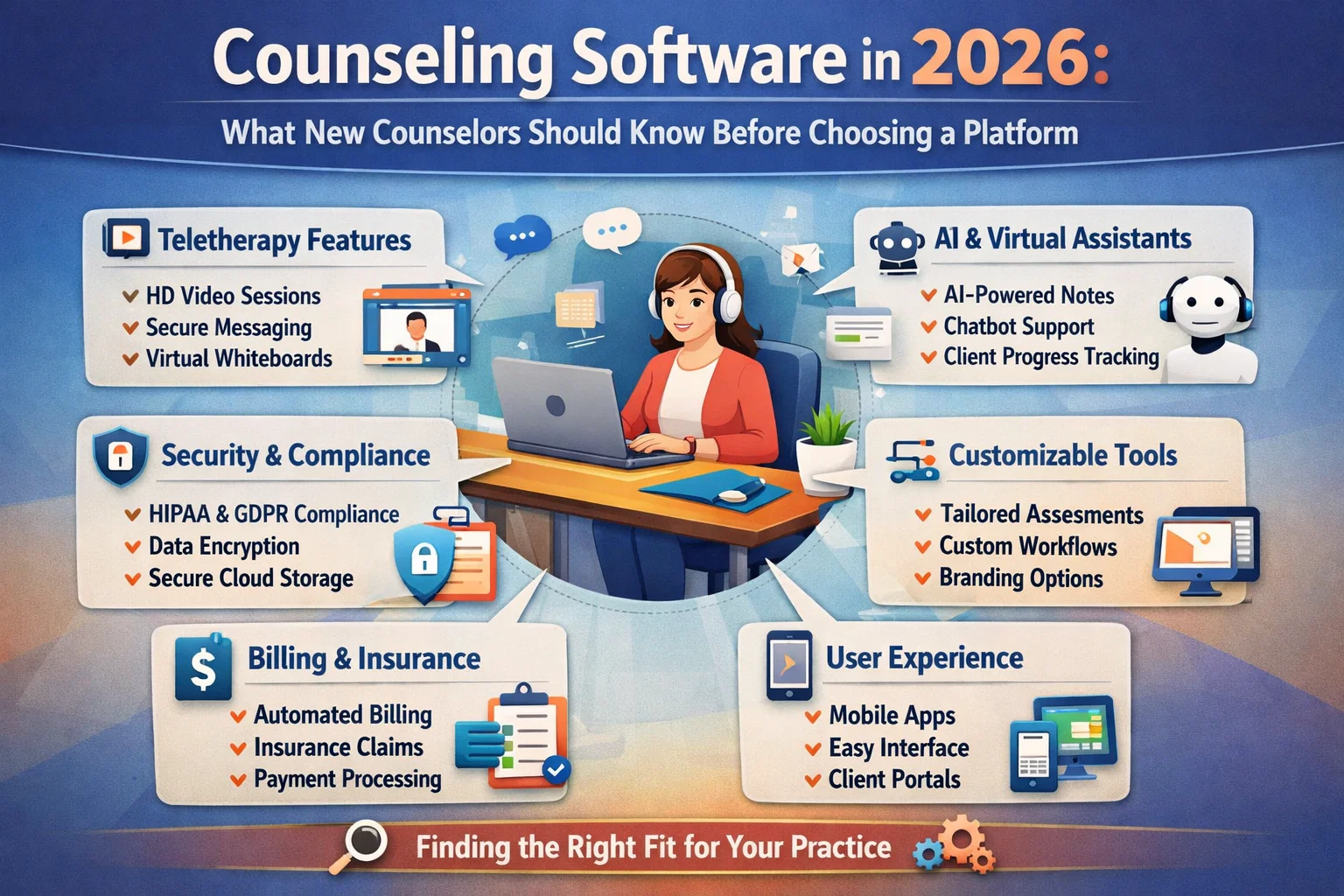
Choosing is not really a software decision first. It is a practice decision. A platform will shape how clients book, how intake is handled, how records are stored, how messages are sent, and how private information is protected. For a new counselor, that means the wrong tool does not just create inconvenience.
It can create confusion, weak boundaries, and unnecessary risk around client care. The HIPAA Privacy Rule protects individually identifiable health information, and the HIPAA Security Rule requires administrative, physical, and technical safeguards for electronic protected health information.
That is why new counselors should not start by asking which platform has the longest feature list. The better question is simpler: which system helps you run a practice clearly, ethically, and safely from the first client onward?
The American Counseling Association’s ethics resources continue to emphasise confidentiality, privacy, and technology-related responsibilities, and ACA’s telehealth guidance makes clear that counselors need to understand the technology they use and its privacy implications.
The Platform Is Part of the Counseling Relationship
It is easy to think of software as something that sits in the background. In private practice, it does not. Clients experience your platform directly through forms, reminders, portals, video sessions, messages, and billing. If those pieces feel messy, the practice feels messy. If they feel secure and clear, the practice feels more trustworthy. ACA’s ethics materials define confidentiality as the counselor’s duty to protect a client’s identity, identifying characteristics, and private communications, which makes platform choice part of ethical practice, not just administration.
That is also why new counselors should avoid choosing a platform based only on branding or convenience. HHS states that the Security Rule protects electronic protected health information through specific safeguards, and its guidance materials continue to focus on how covered entities and business associates should safeguard ePHI in practice.
Start With the Workflow You Actually Need
A lot of new counselors compare platforms the wrong way. They compare every feature available instead of comparing the few workflows they will actually use every week.
Before choosing a platform, walk through a basic client journey:
- A client books.
- They receive intake documents.
- They complete consent and privacy paperwork.
- They attend a session.
- You document the session.
- You handle follow-up, billing, and future scheduling.
If your platform does not make that path simple, it is not the right foundation. HHS says the Privacy Rule covers how protected health information is used and disclosed, while the Security Rule focuses on the safeguards for ePHI, so even a basic workflow has real compliance implications.
What New Counselors Should Prioritise First
Intake and informed consent
Your platform should make it easy to collect intake information, consent forms, privacy notices, and other starting documents before the first session. This is not just about efficiency. It is about clarity. Clients should know what they are agreeing to, what counseling involves, and how their information will be handled. ACA’s 2014 Code of Ethics says counselors inform clients about the limits of confidentiality when using technology and urge them to understand that authorized or unauthorized people may gain access to records or transmissions.
Documentation and record access
Good counseling software should make documentation easy to create, easy to retrieve, and hard to mishandle. New counselors often focus on where notes will be written, but retrieval matters just as much. If you cannot quickly locate a consent form, note, or communication record, your system is not doing enough. HHS says the Security Rule is about protecting ePHI that is created, received, used, or maintained by covered entities, which includes the day-to-day reality of records management.
Scheduling and reminders
Scheduling is not just calendar admin. It shapes the client experience from the start. Your software should let you set clear availability, session lengths, buffers, and reminders. ACA’s telehealth resources highlight that counselors need to understand the technology they use, including practical issues that affect delivery and privacy. A scheduling flow that reduces confusion is part of ethical, competent care.
Communication boundaries
Clients need to know how communication works outside sessions. Your platform should support a clear system for reminders, secure messages if offered, and practical communication without encouraging endless blurred boundaries. ACA’s ethics code and related technology guidance both put weight on confidentiality and caution when information is transmitted electronically.
Privacy and security controls
Before choosing any platform, check what the vendor says about encryption, access controls, data handling, storage, and user permissions. HHS says the Security Rule requires administrative, physical, and technical safeguards. That means you should look beyond interface design and ask how the system protects what it stores.
What Has Changed in 2026
The biggest change is not that counselors suddenly need more software. It is now that technology touches more of the practice than before. ACA’s technology and telehealth resources continue to frame this area as one counselors cannot ignore, and Counseling Today has also highlighted how technology is changing the way providers run their practices.
That means the old way of stitching together email, calendar invites, PDFs, and scattered folders looks weaker now than it used to. Even if a patchwork setup works on paper, it creates more room for errors, confusion, and privacy problems. HHS’s recent Security Rule materials also reflect how seriously the healthcare sector is treating cybersecurity and ePHI safeguards.
What New Counselors Often Get Wrong
They choose for today’s comfort, not tomorrow’s workflow
A platform may feel easy in the first week because it is simple. But the real question is whether it will still feel manageable after dozens of appointments, completed forms, recurring clients, reschedules, and years of records.
They treat privacy as a checkbox
Privacy is not a badge on a website. It is a working reality. HHS makes clear that the Privacy Rule and Security Rule both affect how protected information is handled, and ACA’s ethical guidance reminds counselors that technology use comes with limits and risks that must be explained and managed.
They overvalue features they will never use
A new counselor does not need every advanced capability on day one. The better choice is often a platform that does a smaller number of important things well: intake, records, scheduling, privacy, and communication.
A Better Way to Compare Platforms
Instead of asking, “Which platform is best overall?”, ask:
Does it make the first client journey clear?
A good platform should reduce uncertainty from booking through follow-up.
Does it help me protect information responsibly?
HHS and ACA both point in the same direction here: confidentiality and electronic information handling are central, not optional.
Does it support the kind of practice I want to build?
A solo counselor starting with a few private clients may not need the same setup as a growing group practice. But both need reliable workflows and responsible data handling.
Will I still like this system when I am busy?
That is the practical test many people forget. Software should not only work during research mode. It should work when you are tired, fully booked, and moving quickly.
The Quiet Standard That Matters Most
The best counseling software often does not feel exciting. It feels dependable.
- Clients know what to do next.
- Forms are where they should be.
- Records are easy to find.
- Scheduling works.
- Messages are handled properly.
- Privacy does not feel improvised.
That is a much better sign than a flashy demo. In counseling, steadiness matters more than spectacle.
Final Thoughts
New counselors choosing counseling software in 2026 should think less like shoppers and more like builders. You are not buying a tool in isolation. You are choosing part of the structure that will hold your practice.
The right platform should help you create a client experience that is clear, calm, and ethically sound. It should support how you schedule, document, communicate, and protect information. And above all, it should make the practice easier to run without making care feel mechanical. HHS and ACA guidance both point to the same conclusion: technology in counseling is not just about convenience. It is about responsibility.
FAQs
What should new counselors look for first in counseling software?
Start with intake, documentation, scheduling, communication, and privacy controls. These are the systems you will rely on immediately, and they directly affect client clarity and information handling.
Why does counseling software matter so much for private practice?
Because the platform shapes the client journey from booking to records to follow-up. In private practice, your software becomes part of how care is delivered and how confidentiality is maintained.
Do new counselors need to think about HIPAA when choosing a platform?
If HIPAA applies to their practice, yes. HHS says the Privacy Rule protects PHI and the Security Rule requires safeguards for ePHI, so platform choice matters.
What is the biggest mistake when choosing a counseling platform?
A common mistake is choosing based on surface features or design without checking workflow fit and privacy protections. That usually creates more friction later.
How do I know a platform is a good fit for me?
It is a good fit when it makes your real client journey easier to run, supports ethical communication and documentation, and helps you protect information responsibly.
Visit More : magazineness.co.uk
